
Wilmington VA Employee Fired for Taking Jewelry, Federal Court Upholds
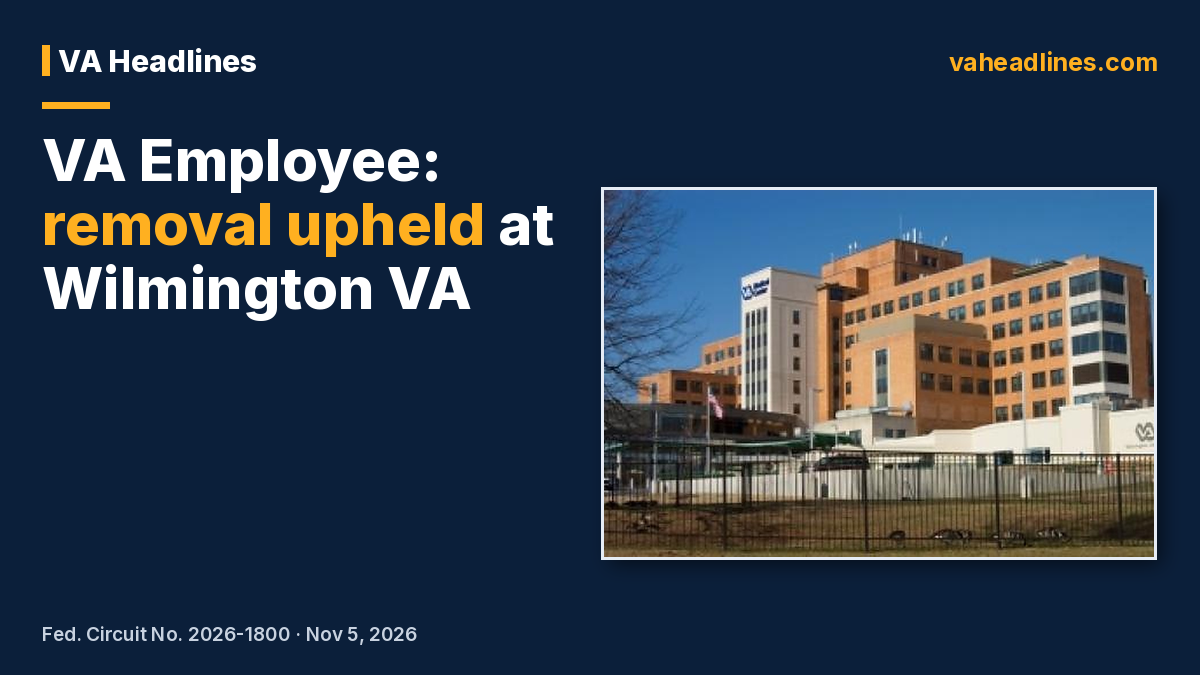
By VA Headlines staff · Published November 10, 2026 · Source dated November 5, 2026 (U.S. Court of Appeals for the Federal Circuit)
The Federal Circuit on Nov. 5, 2026, affirmed VA’s 2018 removal of Valerie Simpson, an Advanced Medical Support Assistant at the Wilmington VA Medical Center, for conduct unbecoming a federal employee.
What happened
The opinion says that on May 4, 2018, Ms. Simpson visited a jewelry vendor, Cheryl Price, at the medical center and left with two jewelry sets for which she had not paid. Ms. Simpson maintained that Ms. Price gave her permission to take the jewelry and pay later. Ms. Price denied doing so.
VA proposed removing her for conduct unbecoming a federal employee. The three specifications alleged that she: (A) took the two jewelry sets without permission; (B) gave inconsistent and untruthful accounts during the investigation; and (C) made statements to VA police about making a "deal" and speaking with Ms. Price to "work things out." Deciding official Vincent Kane sustained the charge and removed her effective July 27, 2018.
How the case reached the Federal Circuit
An administrative judge later sustained the first two specifications, rejected the third, and affirmed the removal in a Dec. 17, 2018, initial decision. The judge also rejected a whistleblower-retaliation defense and concluded that the Douglas penalty factors were immaterial to a removal under 38 U.S.C. § 714.
The Board vacated that decision and remanded on March 13, 2024, for the judge to decide whether Mr. Kane's use of the substantial-evidence standard, rather than the preponderance-of-the-evidence standard, was harmful; whether a protected disclosure contributed to the removal; and whether VA properly considered the Douglas factors.
On remand, the judge again affirmed, in an Aug. 21, 2024, initial decision, and gave no weight to a July 22, 2018, letter purportedly signed by Ms. Price that characterized the incident as a miscommunication. The Board denied Ms. Simpson's petition for review and affirmed on March 9, 2026, in MSPB No. PH-0714-18-0410-B-1. She then petitioned the Federal Circuit, where Circuit Judges Taranto, Linn, and Cunningham decided the case per curiam.
What the Board and the court found
The court held that substantial evidence supported the Board's misconduct finding. The administrative judge credited Ms. Price's account over Ms. Simpson's.
The Board found no abuse of discretion in giving the 2018 letter no weight. It noted that Ms. Price had testified consistently with her original account at the 2018 hearing, and that Ms. Simpson did not explain why a letter she said she already had was never introduced or used to cross-examine Ms. Price. The Board concluded that "the weight of the evidence establishes that [Ms. Simpson] engaged in the misconduct as alleged and the letter does not negate this finding." The court found no reversible error.
The arguments the court rejected
On the standard of proof, the Board recognized that Mr. Kane had applied the wrong standard, but whether that error warranted reversal turned on whether it was harmful. On remand, Mr. Kane testified that he would have sustained the charge under the preponderance standard in 2018, and the judge credited that testimony. The judge also found that the evidence, including Ms. Price's testimony, a police investigatory report, and Ms. Simpson's inconsistent accounts, satisfied the preponderance standard. The court held that substantial evidence supported the conclusion that the error did not affect the outcome.
On the whistleblower defense, the judge found that Ms. Simpson's scheduling complaints were protected disclosures and that proposing official Christine O'Donnell knew of them when she proposed the removal. The Board found that VA proved by clear and convincing evidence it would have removed her anyway. The judge found little retaliatory motive: Mr. Kane did not know of the disclosures, and Ms. O'Donnell testified that she viewed concerns about a widely known scheduling backlog as constructive. Mr. Kane also testified that he was aware of 35 other employees who engaged in similar conduct and were also removed.
On the penalty, intervening precedent required consideration of the Douglas factors for removals under § 714. On remand, the judge credited Mr. Kane's testimony that he had considered the seriousness of the misconduct; his loss of confidence in Ms. Simpson's integrity and reliability; lesser forms of discipline; consistency with the agency's table of penalties and with discipline in similar cases; her length of service; her positive performance history; and her lack of prior discipline. The court found no reversible error.
What's next
The Federal Circuit affirmed the Board's decision and directed that no costs be awarded. This page is about a civil employment action described in an official court opinion. It is not a criminal case.
Related: Orlando clinic CEO and VA employee sentenced in kickback scheme. Former VA employee sentenced for $41,666 PPP loan fraud. More: all VA Headlines reports. How we report: Methodology & Corrections.
Valerie Simpson v. Department of Veterans Affairs, No. 2026-1800 (Fed. Cir. Nov. 5, 2026) (nonprecedential). Review of MSPB No. PH-0714-18-0410-B-1. Affirmed. No costs.
Read the Federal Circuit opinion (PDF)
Facts on this page come only from the Federal Circuit opinion. The 2018 conduct was the subject of a civil personnel action, later affirmed. VA Headlines reports only what official records say. Spot an error? See our corrections policy.