
OIG: VA SPENT $51.7 BILLION FROM THE PACT ACT TOXIC EXPOSURES FUND, BUT VBA COULD NOT RECONCILE COSTS TO ACTUAL WORKLOAD
By VA Headlines staff · Published Nov 23, 2026 · Source dated August 20, 2026 (VA Office of Inspector General)
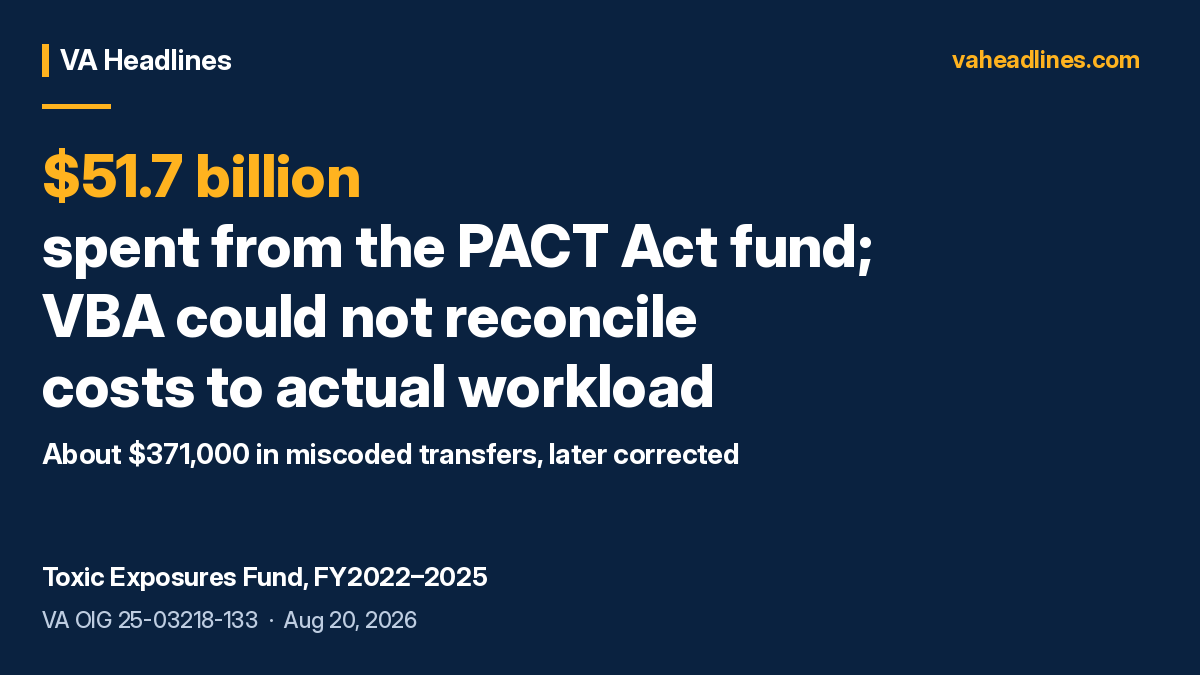
From fiscal years 2022 through 2025, the Veterans Health Administration and the Veterans Benefits Administration spent about $51.7 billion from the Cost of War Toxic Exposures Fund created by the PACT Act, the VA Office of Inspector General reported on August 20, 2026. Congress appropriated about $52.7 billion more to the fund for fiscal year 2026, available until expended. The audit found that VBA could not reconcile estimated Toxic Exposures Fund costs with actual PACT Act-related workload, because none of VA's systems can differentiate or track that work at the individual-employee level and VA does not have activity-based cost accounting.
The audit, VA OIG 25-03218-133, Audit of VHA and VBA Controls Over the Toxic Exposures Fund, is a financial-controls review, not a finding of employee criminal wrongdoing. The OIG made four recommendations to the assistant secretary for management, who also serves as chief financial officer. Richard F. Topping, who holds that office, concurred with all four and provided action plans in a July 17, 2026, memorandum. Assistant Inspector General Larry M. Reinkemeyer signed the report.
VHA had estimation, tracking, and reconciliation methods but needed stronger monitoring of expenditure transfers -- shifts of budgetary resources between accounts that VHA uses because none of its systems can track individual episodes of care related to toxic exposures. The OIG said reliance on those transfers increases the risk that funds will be used for purposes inconsistent with the law. In the files the team reviewed, expenditures inconsistent with authorized purposes amounted to about $371,000, and the facilities later corrected them.
Key findings
- VHA and VBA spent about $51.7 billion from the fund in FY2022 through FY2025. Congress appropriated about $52.7 billion more for FY2026, available until expended.
- In VA's FY2024 spend plan, VHA indicated it would use a $21.6 billion allocation from the fund's FY2025 appropriation for medical care, and VBA planned to use a $1.4 billion FY2025 allocation to deliver PACT Act benefits. VA gave the OIG an updated spend plan in April 2026.
- None of VHA's systems can track individual episodes of care related to toxic exposures, so VHA records use of the fund through expenditure transfers and a reconciliation process.
- One medical facility charged research expenditures to the Toxic Exposures Fund medical-services account, which is supposed to pay for inpatient and outpatient care; VA receives separate research funding under the Consolidated Appropriations Act. The facility attributed the mistake to human error and corrected it in October 2025 after the OIG notified the facility and the VHA Office of Finance. While making that correction, the facility reported another error, and a network interim chief financial officer reported two other facilities that had used incorrect accounts. In total, the errors amounted to about $371,000, and the facilities corrected them.
- VBA staff said none of VA's systems can differentiate or track staff's PACT Act-related workload. Office of Management officials told the team they had not been informed that VBA could not reconcile the fund and did not know whether former chief financial officers had communicated that VBA could not meet policy. After the OIG raised it, VA leaders said they would work with VBA on a feasible reconciliation process.
- As part of a recertification process, in FY2025 VBA authorized 43 fewer central-office employees than were listed in HR Smart for the same period. A VBA employee confirmed that VBA used the fund to pay for more central-office staff than were authorized, including some who should have been reclassified to the general operating expenses account.
How VHA tried to reconcile the fund
The OIG reviewed the FY2024 reconciliation because the FY2025 reconciliation was not completed until April 2026 and used a different process that was not available for review during the audit. VHA officials said they planned to re-do the FY2024 reconciliation using the new process. The OIG said it was not able to evaluate that new process because it was not yet approved or available.
To perform the FY2024 reconciliation, VHA staff multiplied the original proxy by patient-care costs for three veteran eras -- the Vietnam War, the Gulf War, and Post-9/11 -- to calculate allowable expenditures, then compared those amounts to actual Toxic Exposures Fund spending. In December 2024, VHA decided to have medical facilities handle the expenditure transfers instead of the VHA Office of Finance, and the office issued supplemental guidance to the facilities.
The OIG found that internal guidance generally met its intent but that monitoring of the transfers could be improved. Recommendation 2 asks the department to implement monitoring procedures so that VHA expenditure transfers follow the statutes.
VBA could not tie costs to actual workload
VBA's methodology, the OIG found, could not meet policy requirements for reconciling PACT Act-related workload at the individual-employee level. "In other words," the report says, "the systems cannot track the actual activities of a particular staff member or assign costs for specific activities. Consequently, VBA cannot reconcile estimated Toxic Exposures Fund costs with actual workload." Leadership turnover in VBA's Office of Financial Management also stalled progress in documenting procedures, including roles and responsibilities, for managing the fund.
The recertification finding is narrower but concrete: VBA authorized 43 fewer central-office employees in FY2025 than were listed in HR Smart, VA's human resources system, and a VBA employee confirmed the fund paid for more central-office staff than were authorized. Recommendation 4 asks VBA's Office of Financial Management and Office of Human Capital Services to validate the actual number of fund-supported employees and code them properly in HR Smart. In its comments, management said it would also update the estimation methodology so that identifying and coding Toxic Exposures Fund-supported employees in HR Smart "will no longer be required."
Why it matters
The Toxic Exposures Fund exists to pay for health care and benefits connected to veterans' exposure to environmental hazards during military service. The $51.7 billion already spent, and the $52.7 billion appropriated for FY2026, are large enough that the department's ability to show the money was used for that purpose is part of the public record. The OIG did not find that the $371,000 in miscoded charges went uncorrected; the facilities fixed those errors after they were identified. The larger finding is about systems and reconciliation: VHA cannot track individual toxic-exposure episodes of care, and VBA cannot reconcile estimated fund costs to actual workload. Those are control weaknesses the department has now agreed to address.
What VA said
Topping concurred with all four recommendations. The Office of Management said it was finalizing VBA's cost-estimation methodology (recommendation 1, target completion date July 31, 2026); would develop quarterly sampling procedures to monitor VHA expenditure transfers (recommendation 2, March 2027); would assess lessons learned and establish standard operating procedures for reconciling fund costs (recommendation 3, July 31, 2026); and, with VBA, was updating the estimation methodology so that identifying and coding fund-supported employees in HR Smart would no longer be required (recommendation 4, October 1, 2026). The OIG said the planned actions were responsive and would close the recommendations when VA provides sufficient documentation. The July 31, 2026, target dates fall before the report's August 20, 2026, issue date; the published report does not state whether those two actions had been completed by issuance.
What's next
The four recommendations were open when the report was issued. The OIG said it will monitor VHA's and VBA's corrective actions. It also noted that during the audit, supervision of the administrations' finance and budget functions was realigned under the assistant secretary for management to enhance fiscal responsibility; the report does not treat that realignment as a completed fix for the control weaknesses it found.
Sources
- VA Office of Inspector General, 25-03218-133, Audit of VHA and VBA Controls Over the Toxic Exposures Fund, issued August 20, 2026: vaoig.gov report page
- Official PDF: vaoig-25-03218-133_final.pdf
Related: Department of Veterans Affairs (VA) News. More: all VA Headlines reports. How we report: Methodology & Corrections.
Audit of VHA and VBA Controls Over the Toxic Exposures Fund — 25-03218-133, August 20, 2026
Read the OIG report page
Read the official PDF
Facts on this page come only from the OIG report. VA Headlines reports only what official records say. Spot an error? See our corrections policy.