
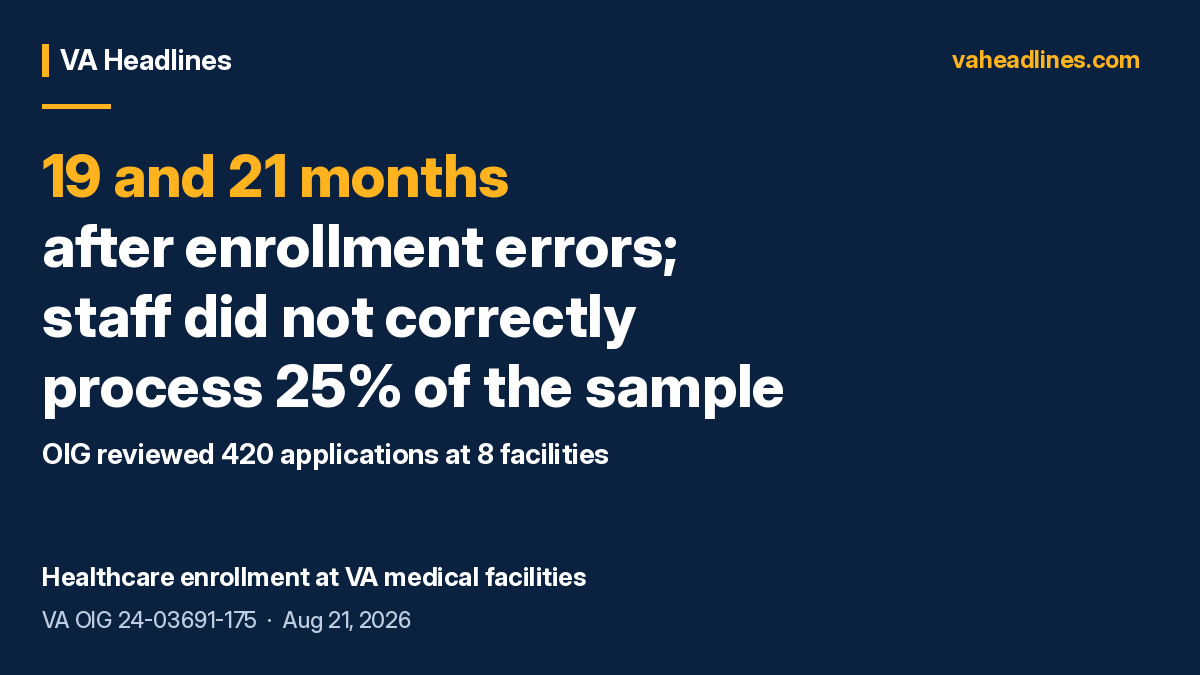
OIG: VETERANS WAITED 19 AND 21 MONTHS AFTER VA ENROLLMENT ERRORS; STAFF DID NOT CORRECTLY PROCESS 25 PERCENT OF SAMPLED APPLICATIONS
By VA Headlines staff · Published Nov 23, 2026 · Source dated August 21, 2026 (VA Office of Inspector General)
A veteran who applied for VA health care at the VA Greater Los Angeles Healthcare System in December 2023 was determined ineligible for having less than 24 months of service, even though a disability discharge exempted the veteran from the time-in-service requirement. Facility enrollment staff later concurred with that analysis. The facility enrolled the veteran in July 2025. Because staff had incorrectly denied eligibility, the veteran's access to VA health care was delayed by about 19 months.
A second veteran, who applied at the VA Maryland Health Care System in July 2023, was placed in priority group 8g -- meaning the veteran was treated as not meeting placement criteria and as having income high enough to deny enrollment. The VA Office of Inspector General found the veteran should have been enrolled in priority group 3 as "permanently retired by reason of physical disability." After a 50 percent service-connected rating in April 2025, the veteran was automatically placed in priority group 1 -- nearly 21 months later than the application information supported. Facility staff agreed.
Those examples come from VA OIG 24-03691-175, Audit of the Healthcare Enrollment Program at VA Medical Facilities, issued August 21, 2026. The Office of Audits and Evaluations reviewed 420 enrollment records created from October 1, 2022, through November 20, 2025, at eight statistically selected medical facilities, a period chosen in part because of an expected influx of applications after the PACT Act. Staff processed 316 of the 420 sampled applications (75 percent) in accordance with all reviewed requirements. For the other 104 applications (25 percent), the OIG said the records "were not correctly processed." In July 2026, Acting Under Secretary for Health John Figueroa concurred with all eight recommendations and provided action plans. Each recommendation's target completion date in the management comments is October 2028. Assistant Inspector General Larry M. Reinkemeyer signed the report.
This is an audit of enrollment processing, not a finding of employee criminal wrongdoing.
Key findings
- Staff processed 316 of 420 sampled applications (75 percent) in accordance with all reviewed requirements in 38 C.F.R. § 17.36 and VHA Directives 1601A.01 and 1601A.02. The other 104 applications (25 percent) were not correctly processed.
- Applications were missing or not date-stamped for 58 of 420 records (14 percent), which prevented the team from assessing whether those applications were processed properly or on time.
- For 43 of the sampled applications (10 percent), staff misinterpreted, overlooked, or inaccurately entered information, resulting in incorrect eligibility or priority-group determinations. In 25 of 420 records (6 percent), overlooked or inaccurately entered information caused an incorrect priority group.
- Nine of the 420 sampled applications (2 percent) that had date stamps were not processed within five business days, the time frame in VHA Directive 1601A.01.
- At five of the eight facilities visited, enrollment staff or other intake personnel told the team they do not enter a veteran's application into the enrollment system as required unless all information is available.
- Community-based outpatient clinics at five health care systems sent applications by methods that could delay processing, including mailing physical copies, which enrollment staff said can take between one and two weeks. A staff member at one system said some clinics waited until they had a "stack" of applications before mailing them to the parent facility.
The eight facilities in the sample
The audit assessed records from eight statistically selected sites, listed in a footnote on page 5 and in Table B.1 in appendix B:
- Lebanon VA Medical Center in Pennsylvania
- VA Maryland Health Care System in Baltimore
- Columbia VA Health Care System in South Carolina
- VA Northern Indiana Health Care System in Fort Wayne and Marion
- Alexandria VA Health Care System in Pineville, Louisiana
- Central Texas Veterans Health Care System in Temple
- VA Eastern Colorado Health Care System in Aurora
- VA Greater Los Angeles Healthcare System in California
The OIG also examined enrollment records and procedures through January 2026 to account for evolving eligibility criteria. VHA told the team that, from October 2022 through October 2025, medical facilities manually processed 68 percent of enrollment applications and the Health Eligibility Center processed the other 32 percent.
How errors delayed care
Enrollment decisions determine whether a veteran receives care, what services are available, and any out-of-pocket cost, the report says. Healthcare enrollment can also be a gateway to other VA benefits and services.
Once staff identify enough evidence for an enrollment decision, the system places the veteran in one of eight priority groups. In the Greater Los Angeles example, staff denied enrollment for insufficient time in service even though a disability discharge made the veteran eligible. In the Maryland example, staff missed evidence that the veteran had been permanently retired for a physical disability and should have been in priority group 3. The later 50 percent rating moved the veteran into priority group 1 automatically, but that was nearly 21 months after the application information already supported enrollment.
The 19- and 21-month delays are individual examples in the official record, not averages for the full sample.
Intake practices and secondary review
The report says facility-level intake practices kept some applications out of the enrollment system and could delay processing. At five of the eight sites, staff said they wait until all information is available before entering an application, contrary to the requirement to enter it. The OIG recommended comprehensive national policy on applications that are missing information, including a firm requirement that staff enter incomplete applications in the enrollment system.
Separately, facility enrollment staff are required to notify the Health Eligibility Center of veterans assigned to lower priority groups -- groups 7 through 8g -- who may qualify for a higher level of services after the PACT Act's eligibility expansion. The center's quality-assurance reviews do not otherwise proactively evaluate all veterans in those groups. If facility staff do not notify the center, the OIG said, VHA lacks assurance those records will receive a secondary review.
Oversight also varied. Four of the eight Veterans Integrated Service Networks the team examined were independently assessing the facility enrollment program; the others only monitored reports of results from the Health Eligibility Center's audit tool.
Why it matters
For eligible veterans, enrollment is the door to the care they have earned. The OIG found that three in four sampled applications were processed according to the requirements it reviewed. The remaining quarter was not. Some of those problems were missing or undated applications that could not even be checked. Others were wrong eligibility or priority-group decisions, including the two cases in which veterans waited about 19 and 21 months after errors the facilities later agreed had occurred. The audit does not claim those wait times apply to every missed case. It does show that when staff get an enrollment decision wrong, the delay can be measured in many months, not days.
What VA said
Figueroa issued VHA's comments in a July 20, 2026, memorandum and concurred with recommendations 1 through 8. The action plan says the Health Eligibility Center will write clearer national requirements for processing applications, including incomplete ones; coordinate with the Veterans Benefits Administration on streamlining enrollment in both administrations; define guidelines for applications received at community-based outpatient clinics; and standardize how networks and facility enrollment coordinators oversee the program, including whether coordinators nationwide should be required to use the center's audit tool.
Every recommendation in the comments is marked in progress, with a target completion date of October 2028.
What's next
The eight recommendations remain open on the published report, with targets in October 2028. During the audit, the VA Secretary announced in December 2025 a reorganization of VHA's management structure. In January 2026, VHA officials told the team they were considering centralizing the enrollment function, but enrollment activities at medical facilities and the Health Eligibility Center had not yet changed. The OIG discussed the results with VHA again in June 2026 before issuing the eight recommendations.
Sources
- VA Office of Inspector General, 24-03691-175, Audit of the Healthcare Enrollment Program at VA Medical Facilities, issued August 21, 2026: vaoig.gov report page
- Official PDF: vaoig-24-03691-175_-_final.pdf
Related: Department of Veterans Affairs (VA) News. More: all VA Headlines reports. How we report: Methodology & Corrections.
Audit of the Healthcare Enrollment Program at VA Medical Facilities — 24-03691-175, August 21, 2026
Read the OIG report page
Read the official PDF
Facts on this page come only from the OIG report. VA Headlines reports only what official records say. Spot an error? See our corrections policy.